
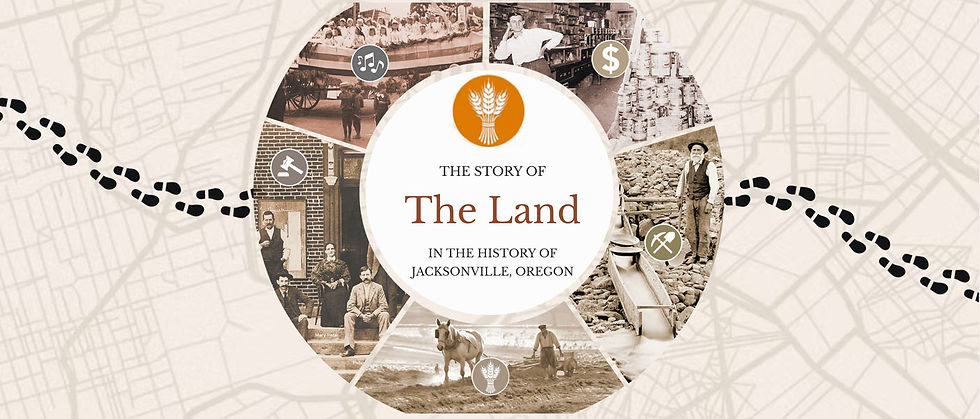


THE LAND
Jacksonville’s story begins long before the discovery of gold.
Before miners and settlers arrived, the region was a landscape of oak savannas, woodlands, creeks, and seasonal floodplains that supported abundant plant, animal, and human life. For thousands of years, Indigenous peoples, including the Upland Takelma (Latgawa), lived in close relationship with the land, using fire, seasonal movement, and trade networks to sustain thriving communities throughout the Rogue Valley.
In the early 1850s, the discovery of gold transformed the region almost overnight. Prospectors poured into Southern Oregon, temporary camps became permanent settlements, and Jacksonville quickly emerged as one of the area’s earliest and most important mining towns. As mining expanded, so did trade, transportation, and cultural exchange, permanently reshaping the landscape and economy.
When the gold rush declined, Jacksonville evolved again. Agriculture, orchards, vineyards, and ranching replaced mining as the region’s economic foundation, supported by fertile soils, established irrigation systems, and a Mediterranean climate well suited for farming and viticulture.


Today, Jacksonville’s “new gold” includes not only wine and agriculture, but also recreation, conservation, and heritage tourism. Historic streets, preserved woodlands, scenic trails, and vineyard landscapes continue to connect residents and visitors to the area’s layered history. Organizations such as the Jacksonville Woodlands Association have helped preserve the natural beauty and cultural character that make Jacksonville unique.
Dedicated conservation efforts, like those managing the Jacksonville Woodlands trails, actively preserve remaining pockets of native biodiversity. These protected areas safeguard critical habitats for local wildlife and plants, including the endangered Gentner’s fritillary lily.


Explore the Story of the Land in Jacksonville, OR in Real Life
Jacksonville, Oregon is a walkable historic landmark. We encourage you to explore Jacksonville for yourself in real life. Below you'll find some links to real life experiences related to the story of "The Land".
-
Outdoor Adventures: Hike the scenic trails of the Jacksonville Woodlands system-18 miles of trails that start and finish at and just above the Britt Festival grounds and gardens, and at the Beekman Arboretum just above the historic Beekman House. Less than one mile west of downtown on Highway 238, the Jacksonville Woodlands maintain 42 additional miles of hiking and biking trails at the Forest Park complex, which features three main trailheads and associated parking lots.
-
Jacksonville Wine Trolley provides a hop-on, hop-off service (Fri-Sun) to roughly five Southern Oregon wineries with a $30 day pass, including free tastings and 10% discount on purchases at participating locations. Seasonal.
-
Jacksonville Historic Cemetery Talks and Tours: Second Saturdays, May through September, 10 a.m. at the Sexton’s hut at the top of the Jacksonville Cemetery hill. Free presentations on pioneer life followed by short walking tours to grave sites related to the day’s lecture topic. Approximately 90 minutes for the lecture and tour.

THE LAND
Virtual Tour of "The Land" Display at the Jacksonville History Center in Oregon


THE LAND
Join Us on a Deep Dive Back in Time...
The Land
Before Jacksonville, there was the land- a broad, sun-drenched savanna where sturdy oaks and native grasses mingled side by side. Along its margins, cool creek corridors traced the land beneath the shelter of willows and other water-loving plants, while shifting floodplains rose and fell with the seasons. The mixed woodlands were made up of white and black oaks, Pacific madrone, Ponderosa pine, and Douglas fir. Between the upland trees and the wet corridors, fire regimes and seasonal moisture helped keep the landscape open and patchy.
The People
Evidence suggests that humans first moved through the area that is now Jacksonville 14,000 to 18,00 years ago when the climate was wetter, colder, and a frost-dominated glacial landscape. Archaeological and ethnographic patterns indicate that early movement through the region was seasonal and opportunistic, following game migrations, the timing of plant emergence, and the shifting availability of water. Just prior to the arrival of pioneers, the area that is now Jacksonville was inhabited by the Upland Talkelma (Latgawa), who maintained a complex, subsistence-based society that thrived on the abundant acorns, camas bulbs, berries, and salmon. Native residents used fire to clear underbrush, encourage camas root growth (a staple food) and create open savannas for hunting deer and elk. The Talkelma maintained a complex and far-reaching trade relationship that involved economic exchange with other, nearby indigenous groups, including bands of people often referred to as the ‘Rogue River Indians,’ who camped primarily along Applegate Creek and the Rogue River. They also traded with the Modoc and Klamath tribes, who inhabited the nearby Klamath Basin and areas to the east, as well as with the Shasta people, who lived in the highlands of the Rogue Valley and surrounding mountains. Trade included regional resources like camas root, salmon, berries, deer and elk meat and skins, and acorns. Following the arrival of the Hudson’s Bay Company in the 1820s and 1830s, the trade economy shifted toward beaver pelts. By the 1850s, trade shifted again to include food and supplies with the influx of miners during the 1850s gold rush.
The Switch to Agriculture
Following the decline of the gold rush, Jacksonville established itself as the center of a newly emerging agricultural economy, with orchard fruits- primarily pears and apples, viticulture (grapes) and livestock ranching. Jacksonville transitioned from a bustling 1850s gold rush town into an agricultural, service-based community. The agricultural turn that followed the gold boom did not erase the older relationships between water, soils, and seasonal work; it reorganized them. Communities that had functioned as mining camps and resupply stops gradually settled into fields, orchards, and stock routes.
Grapes and Recreation, the New Gold
Today, Jacksonville offers an immense recreational richness. The story of Jacksonville’s “new gold” begins with grapes, but it quickly widens beyond vineyard rows. As orchards expanded and matured, viticulture became a cash crop that could fit both small holdings and more coordinated enterprises, while the irrigation systems already established for pears and apples were adapted to manage heat, wind, and the risks of frost. Alongside agriculture, recreation entered as a quieter layer of the regional economy. By the late nineteenth century, summer travelers and short-term visitors sought cool creek bends, orchard shade, and cultivated viewpoints, turning portions of the corridor into staged landscapes for leisure. The visible pleasures of shade, birdsong, and “restored” banks take center stage. Founded in 1989 by local residents to protect forested hillsides from development. The Jacksonville Woodlands Association (JWA) is a non-profit, volunteer-driven organization that has preserved over 320 acres in 22 parcels as a natural park surrounding 705 of Jacksonville. The JWA developed 18 miles of interpretive trails showcasing 1850s gold rush history and connects partners like the BLM (Bureau of Land Management) and the City of Jacksonville to maintain this “emerald necklace” of public land.
